1.Epitaph of a moment in time
When people think of what things to save from a house fire, photos usually pop up in their minds first. Although nowadays this usually means saving an external hard- disk rather than an old photo album, photos still are considered both very personal and valuable items, if only it were for their irreplaceability. At the same time this is what makes most photos very impersonal to us, since they depict persons and events familiar to just a few people.That having said, photos of subjects we have no personal relationship with, can have very personal effects. And whether walking on the street or browsing the web, we are surrounded by photos of people we do not know, that we will never meet or that may not even be alive. By association these images can evoke very personal reactions, however. Photography, by it's very nature, has always been both an extremely personal and very impersonal mode of (re)presentation. Unlike the painter or the poet, the photographer has a machine that with a push of the button can record any image that hits the surface of the film or the sensor. There is the potential of control by adjusting the perspective, aperture, post production and so on, but there also is the potential of the random: just push the button without even looking and some usually figurative image will come out no matter what. With the introduction of colour photography and further technical perfections, making a photo of an image that looks the way we (think) it was, has become easier and easier. Ironically, we now try and achieve the opposite by means of Instagram filters, Photoshop and for example lomography.
There are many ways to qualify photos and divide them into different categories, but when I am browsing through my photos on a hard-disk or see photos online, the most obvious distinction is that between personal photos and impersonal photos. I see the pictures of people I know, places where I have been and photos that other people took of things that are mostly unknown to me. Thinking about photos in this way it seems that a photograph can derive it's value from three different types of (re)presentation: the personal, the semi-personal and the impersonal. This is a practical distinction, as I will try and show you.
2. Types of photographs
I. Personal photos: the re-appearing image
A photo is by it's very nature a mimetic image, a camera being a xerox machine that can copy whatever the photographer sees. Often a photo is supposed to record an event that someone wants to remember or show to others and the value of the photo depends largely on the extend to which (the feeling of) a past personal event can be evoked by looking at the photograph. This is what I call the re-appearing image, because it is about making a past event re-appear as it once was. But the distinction between different types of photos is not that hard. The famous series Autoportraits from Martin Parr shows that a photo that is quite personal- ironically taken fully automatic by a machine- can become a semi-personal one by showing it to people in a specific context.
II The semi-personal photo: the appearing image
Of course, many photos we see depict people or things that we have never met or seen in real life. But these persons and objects can be familiar to us because we have seen them on tv or they have an obvious symbolic value, for example a uniform or a rocket. These photos are personal by association rather than by (a memory of a) personal experience and especially advertisements play with these associations in a usually effective way. Since these photos can not revive a memory of the photographed scene, we come up with our own experience when seeing for example a photo of a movie star sitting in a shiny car or a small kid in a desert. Also a personal photo can become a semi-personal one. When we see a wedding photo from the Thirties for example, we come up with a fantasy world, with our own interpretation based upon our own experience and common knowledge. We could also easily get all nostalgic about things that happened before we even existed, if they indeed actually happened at all (since it is very easy to fake or stage some sort of event). For me, the most effective semi-personal type of photo is the one that evokes or underlines a personal yearning, saudade as the Portuguese would say. The semi-personal type of photo is the type I call the appearing image, because we construct a reality, an experience and make something appear that was not there before.
III The Impersonal photo: the disappearing image
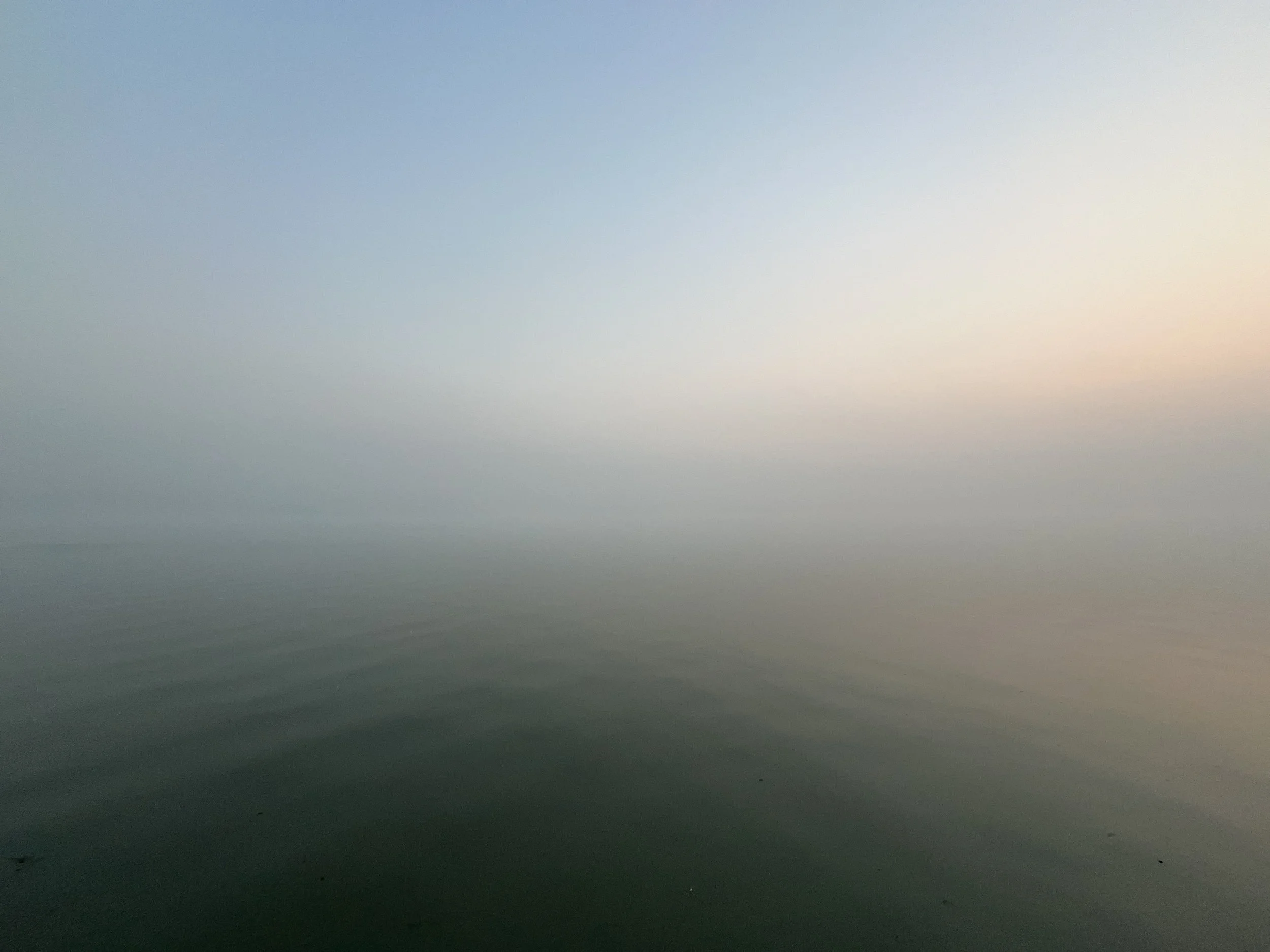
A photo is always the recording of a moment in the past. A moment of usually less than a second becomes something of indefinite length and a three-dimensional scene becomes a flat image. But a photograph does not show a particular scene at a certain time as much as it does the disappearance of time and space, the disappearance of what is not depicted. Unlike a photo of a familiar person or a specific event such as a sports moment or a war scene, the impersonal photo does not evoke a moral or esthetic judgement or personal memory. In stead, it frees us of these constructs by raising questions, more so than raising answers and by showing absence rather than presence. This type of photo I call the disappearing image, because by looking at it, we can loose ourselves in what we see by not being caught up in reflections, but by being lured by the sirens of negative space (and time) due to an image that is vey much de- emphasized. This type of image does not call upon our immediate judgement, but we loose ourselves into the void of what is missing in the photo, of what is suggested in this two-dimensional image and is not there. One would say an abstract image is easier to achieve this type of effect and I think it is. I believe Jean Baudrillard, as a photographer, made images like this. But an impersonal image does not have to be an abstract image. A lot depends on the way we look at an image, like our level of concentration. A good example is the way Robert Wilson describes his motivation for making theater the way he makes it. Once he was just sitting in the kitchen, looking through the window. He saw a cow standing in a meadow. All the cow did was moving her head a little bit. He kept watching this cow doing essentially nothing for hours, after which he said that this is the type of theater he wants to make. And this is the type of image that I want to make, meditative tickets to outside, to what is outside of what we we and who we are.
3. The valuable image
Whether a photo is a self portrait or a family photo or a photo of a rock, once the photo is taken we can look at something that can exist perfectly well without us in a reality of it's own, unlike for example a musical performance or a play. In this perspective, it is easy to think of the virtualization of the world view as a hyperreality that can seem more real than the one we can not see because of the way events are being depicted and media. Yet, in stead of defining reality, it seems more interesting to find a way of defying reality. <br/><br/>With defying reality I refer to looking at an image in a pre-reflective mode and in stead of being conscious of a certain set of meanings and values, we look at an image in a more subconscious way. When a photo does not depict someone we know or a scene full of specific meaning, such as a facial expression or the Eiffel Tower, this is much easier to do. A photo should really not show something we immediately recognize and value, but it should show the absence of meaning and essentially the absence of ourselves.
We disappear, once we free ourselves from morals and symbols and look at a photo that is the negation of what we cannot see. In such a photo we cannot only experience the disappearance of time and space, but more so of ourselves, by looking into a void where we are not. This type of photo generally evokes a question rather than an answer or a specific meaning. As Baudrillard stated in Ecstasy of Communication: To disappear is to disperse oneself in appearances. When we see a picture of a rock in a desert, it is not like we become the rock and loose ourselves this way.
We experience the apparent disappearance of oneself by embracing the other appearances, in a pre-reflective mode or rather the unconscious conscious and we do so by not looking past the surface. We see something that simply is and the context- what might explain the questions the photo can raise- has disappeared the moment the photo was taken. When we see a picture of a birthday cake, we do not miss a context, we see something that probably makes us happy or hungry.
When we see a picture of a rock, it is not like we automatically consciously ask ourselves questions about it’s context. But a good photo does trigger this type of questions and before trying to answer these questions or even thinking about them, we experience the void from which the stone was taken. A void we fill in by ourselves, acknowledging the appearances of what we can not see, what has disappeared.
The depth really lies within the surface and a photograph being two-dimensional is a practical instrument to focus on just that: to go a little bit deeper than what we can think.
Part of the attraction of a photo is that it depicts something that can exist perfectly without us and continues to do so within the two-dimensional frame of the print. The (semi-)personal image is attractive, because it evokes well known persons, things or events. This can give a photo a very emotional effect, but also one very bound to a certain perspective and a set of values, being more volatile than the absence of this.
This does not mean a personal photo is less valuable than an impersonal one, but it does mean different types of photos can have different types of effect. Whereas the personal photo can evoke a very emotional experience, the impersonal photo can evoke an existential one. Ironically, by loosing ourselves with a look that is without judgment, we find ourselves in all types of appearances.
For me, a good example of a photographer that makes photos with an ultimate effect is Hiroshi Sugimoto, doing so by photographing objects out of focus, or making the moment of taking a photo last very long.
Again, we become part of the outside, of what was and will be, even without us. Sometimes it is difficult to look this unjudgmental at - for example- an old wedding photo or a smiling face. Yet, when seeing a photo that primarily shows the negation of such events, of something that emphasizes the absence of feelings of happiness or things we can only guess, we can look without moral or judgment.
This does raise the question whether looking at something in a pre-emotional way brings us to a deeper level of experience, as looking at something in a pre-reflective way can achieve this.
4. Outside
The disappearing effect is not something unique for photography. In the 17th century paintings of landscapes became popular for example, and unlike most paintings before that time they were without a specific dramatic scene on in the foreground or as subject. It was all about the clouds, the grass.... One could argue these painting were essentially visual elevatior music. But I tend to disagree, although they certailny might have been used like that or were viewed by people that way. Modern painters were able to leave even less by painting in a more abstract fashion, such as Mondriaan in his later work and Rothko. In these painting we can find depth within lines or colour... The depth is on the surface as designer Robert Wilson would say.
It is not without reason that a lot of people love staring at an open fire, or out of a moving train. This art of staring we are starting to loose, when looking to all the visual input on the street, from our phones and online.
A good photo can indeed remind us of the importance of looking.
So the greatest potential of the photo is not what it shows, but what it does not: what has disappeared. A good photo raises questions, not judgment. Essentially, when looking at such a photograph, we disappear ourselves and by the cool gaze of the unconscious mind we find ourselves in appearances, outside. Somehow this is a comforting thought: we become part of what exists without us, what remains.
To me, therefore, a good photo is not one of something that is per se beautiful, cute or documentary.
A good photograph is not just an epitaph of a moment in the past, but a prelude to our own disappearance.
It reminds us that in the end we will not be alone: we will be outside.